React
January 15, 2024
12 min read

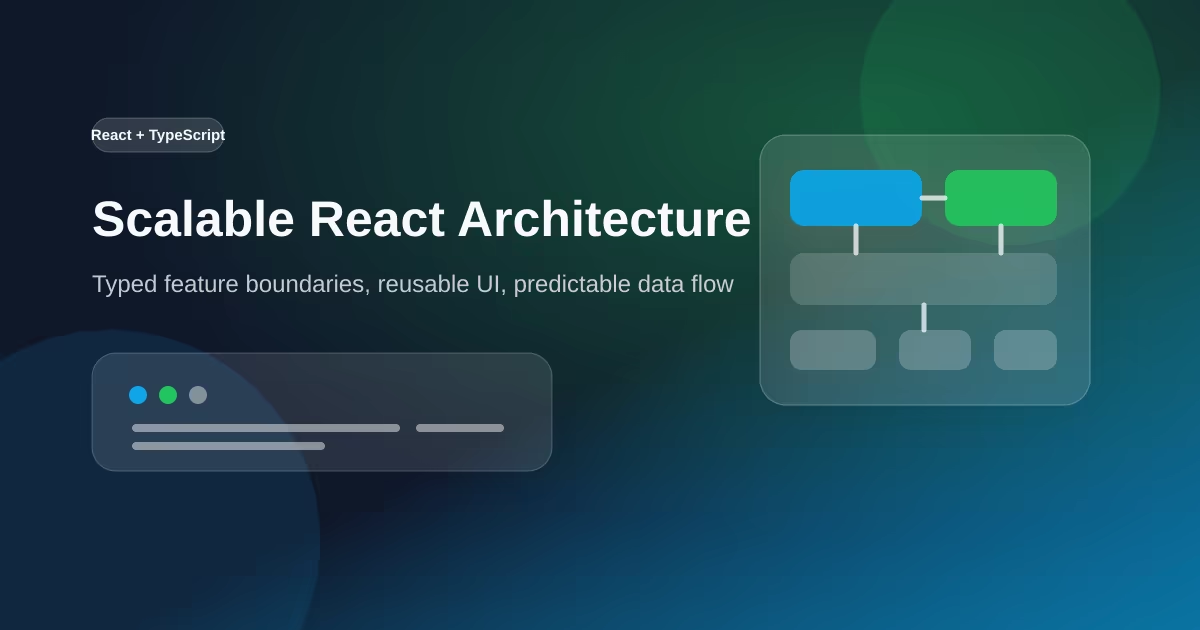
Building Scalable React Applications with TypeScript

Learn best practices for structuring large-scale React applications with TypeScript, including type safety, code organization, and performance optimization.

Building Scalable React Applications with TypeScript

Introduction

Building scalable React applications requires careful planning and adherence to best practices. In this comprehensive guide, we'll explore how TypeScript can help you build more maintainable and robust applications.

Type Safety Benefits

TypeScript provides compile-time type checking, which helps catch errors early in the development process. This is especially valuable in large codebases where manual testing of all code paths becomes impractical.

Key Advantages:

  • Early error detection during development
  • Better IDE support with autocomplete and IntelliSense
  • Self-documenting code through type definitions
  • Easier refactoring with confidence

Project Structure

A well-organized project structure is crucial for scalability. Here's a recommended approach:

src/
  β”œβ”€β”€ components/
  β”‚   β”œβ”€β”€ common/
  β”‚   β”œβ”€β”€ features/
  β”‚   └── layouts/
  β”œβ”€β”€ hooks/
  β”œβ”€β”€ services/
  β”œβ”€β”€ types/
  β”œβ”€β”€ utils/
  └── pages/

Component Patterns

Use composition over inheritance and keep components focused on a single responsibility. TypeScript interfaces help define clear contracts between components.

State Management

Choose the right state management solution based on your needs. For TypeScript projects, consider Redux Toolkit or Zustand for their excellent TypeScript support.

Performance Optimization

Leverage React's built-in optimization features like React.memo, useMemo, and useCallback. TypeScript helps ensure you're using these correctly.

Conclusion

TypeScript and React together provide a powerful foundation for building scalable applications. Start with strong typing, maintain good project structure, and follow React best practices for optimal results.

Field Notes From Production React Work

The biggest scalability issue I see is not usually a missing library. It is unclear ownership. Components fetch data directly from anywhere, forms know too much about server responses, and feature folders become a mix of UI, validation, state, and API calls. TypeScript helps only when those boundaries are named. A typed mess is still a mess; the goal is to make the shape of the application obvious to the next developer.

For client projects I normally start by separating product language from technical structure. A feature such as booking, checkout, or lead capture gets its own data shape, validation schema, and UI entry points. Shared components stay boring and generic. Business rules stay close to the feature that owns them. This keeps refactors cheaper because a pricing change, form change, or API change does not ripple through unrelated screens.

I also treat TypeScript errors as design feedback. If a type needs repeated casting, the model is probably wrong or too vague. A good type should make illegal states harder to represent, especially around loading, empty, failed, and submitted states. That discipline is what keeps a React app maintainable after the first release, when real users start asking for edge cases the original design did not include.

Implementation Checklist I Use Before Publishing

Before I publish a technical or marketing page, I run through a small checklist that connects engineering quality with business outcomes. The page must have one clear reader, one primary action, and enough supporting detail to answer obvious objections. For a technical article, that means examples, tradeoffs, and implementation notes. For a service page, it means deliverables, proof, timeline, and the next step.

I also check the page from a performance angle. Images need explicit dimensions or reserved aspect ratios so the layout does not jump. Below-the-fold media should lazy-load. Client-side JavaScript should be limited to the interactions that truly need it. If a page is mostly text, cards, and images, it should not ship a large animation runtime just to fade in content that could have appeared immediately.

Metadata is part of the content, not a final decoration. Titles should be specific enough to be useful in search results and short enough to avoid truncation. Descriptions should summarize the page with concrete terms, not repeat the title. When a page exists in English and Indonesian, I avoid duplicate title values by giving each version its own search snippet and language-specific framing.

Finally, I look for visible trust signals. Readers should know who wrote the page, when it was updated, and why the author has enough context to make the recommendation. This is especially important for portfolio, service, and technical pages because the site is selling judgment as much as code. A byline, project evidence, external profiles, and clear update dates make the page easier to trust and easier for search systems to interpret.

Localization, Proof, and Maintenance Notes

For bilingual websites, I avoid treating translation as a copy-paste task. The English page and Indonesian page can discuss the same subject, but each version still needs its own search title, description, and natural phrasing. This prevents duplicate snippets, gives search engines clearer language signals, and makes the page feel written for the reader rather than mechanically mirrored.

I also keep a small maintenance log for important pages. When a framework changes, a package releases a new major version, or a business offer changes, the page should be reviewed instead of left frozen. The update does not always need a rewrite. Sometimes it is enough to adjust a section, refresh examples, add an implementation note, or clarify a tradeoff that became more important after launch.

The last review is usefulness. If a paragraph only exists to make the article longer, it should be cut or replaced with a concrete example. Good SEO content is not padded; it is specific. It explains the decision, shows the constraint, and gives the reader a next action they can apply to a real project.

Questions I Ask During Review

I ask whether the page would still be useful to someone who skips the introduction and lands in the middle from search. Each major section should stand on its own with a clear heading, a direct answer, and enough surrounding context to prevent misinterpretation. This makes the article easier to scan and also helps individual passages work as citation candidates in AI search results.

I also check whether the recommendation would change for a smaller business, a larger product team, or a maintenance project. If the answer is yes, the article should name that difference instead of presenting one universal rule. Real projects have budgets, deadlines, existing code, brand constraints, and team skill levels. Good advice respects those constraints and explains when a simpler option is the better engineering choice.

That is the standard I use for client-facing content too. A page should not only describe what can be built; it should help the reader decide what should be built now, what can wait, and what risk the decision reduces.

When the answer is uncertain, I prefer naming the assumption openly. Clear assumptions make future updates easier and help readers adapt the recommendation to their own project instead of copying it blindly.

Practical review points

  • Can a reader understand the page goal within the first screen?
  • Does every section move the reader toward clarity, proof, or action?
  • Are images sized, compressed, and relevant to the real offer or example?
  • Is the page still useful without animation, hover states, or JavaScript-only behavior?
  • Would the metadata make sense if it appeared alone in a search result?

This checklist keeps content from becoming thin filler. The goal is not to hit a word count for its own sake. The goal is to give enough context that a serious reader can make a better decision: what to build, what to avoid, and what tradeoffs matter for their situation.

Dicco Suryo Kartiko β€” Fullstack Developer

Written & maintained by

Dicco Suryo Kartiko

Fullstack Developer Β· Yogyakarta, Indonesia

Fullstack developer with 4+ years of experience shipping production web apps and conversion-focused websites. I've worked on enterprise software at Hashmicro and Nawadata and built landing pages, company profiles, and web apps for service businesses across Indonesia. Everything on this page is written and maintained by me directly.

GitHubLinkedInLast updated: 2024-01-15